Isn’t contentment about contrasts? Surely if you awake
content every morning, then life would seem oh so dull.
I’ve been expressing a bit of discontentment lately – with rowing
up and down the same bit of the River Cam for some years, so when my friend
Jane organised a charity event to row from Cambridge to Ely, I was keen to sign
up. Our regular training outings take us a couple of miles from the boathouses
overlooking Midsummer Common down to Baits Bite Lock, whence it is only a
couple more miles to Waterbeach, which is about half way to Ely. It would be a
doddle, I thought. But then – when I read the info a couple of days before the
event – someone described the row as gruelling. I shouldn’t have just thought
of gruel, and the porridge I’d make the morning of the row. I should have been forewarned.
It was snowing when I woke that morning. It was going to be
cold. Really cold. And the challenge of rowing when it is really cold it what
to wear. You start with too much on, but once warmed up the whole boat has to stop
to strip off. But lots of layers it had to be. Under Armour and trackie bottoms, thin
socks, thick red climbing socks, t-shirt, long-sleeved rowing top, fleece, splashproof top,
silly hat and scarves – one silk, one wool.
 |
| Getting fettled at Clare Boathouse |
The warm up row down to Baits Bite Lock was sedate, and
looked quite pretty with snow flurries playing around Stroke’s black fleece outfit.
There was no pressure on this trip. I could look around and enjoy the scenery,
and nod cheerily to the other nutcases who were out walking or fishing on a
morning like this. There’s camaraderie amongst nutcases. Mallards laughed at
us. Gulls swooped down around us.
 |
| Baits Bite Lock |
 |
| Baits Bite Lock, preparing to carry the eight |
At the lock, 2.6
miles from the start of the row, there were trusty, chilly volunteers to help
us carry our rowing clutter, the oars and the boat around the lock. I took off
my fleece and Stroke exchanged a fleece hat for a peaked cap. Back in the boat,
oars back in their gates, we pushed off and set off along the most delightful
stretch of river. Pollarded willows over hung this deep but narrow section,
where moorhens hooted at us. Grey fans of fleeing wood pigeons. I spotted a few shy dabchicks – cute little birds
with an astonishing capacity for underwater swimming. I was sitting behind a
new stroke, and she set a metronomic rhythm. I could feel how well we were all
in time. Our excellent cox kept up a constant flow of commands to keep us in
time. Catch – together. Pull together. Slide – together. It felt good. The
rhythm, when it is this good, is mesmerising.
We paddled through Horningsea and then the countryside
started to open out. It began to feel like we were in The Fens. The soggy
riverbank was pockmarked with evidence of water voles. More dabchicks. Even
cormorants. In several places drains joined the river, and I thought about the
engineering that had been done to keep this part of East Anglia above water. Then
slightly to my surprise, cox said, ‘I can see the lock!’
 |
| Entering Bottisham Lock |
 |
| Inside Bottisham Lock |
We were the tail-enders of several eights doing this row,
and cox said she could see boats waiting to go through Bottisham Lock. This was
5.6 miles from the start. I wondered how scary this would be. Generally rowing
eights are very stable – because there are eight outriggers to stop them
capsizing. But the can and do capsize. The lock is tiny – too narrow to allow
the oars to rest on the water. There would be turbulence as the water was let
out. And swimming in the Cam in February, certainly didn’t appeal. We watched
other boats negotiate the lock. They needed more chilly volunteers to help them
through because it was too narrow to be able to paddle anywhere.
Finally it was our turn and the volunteers decided that two
eights would fit inside the lock. Efficiently we glided in, waited for the water to fall and we
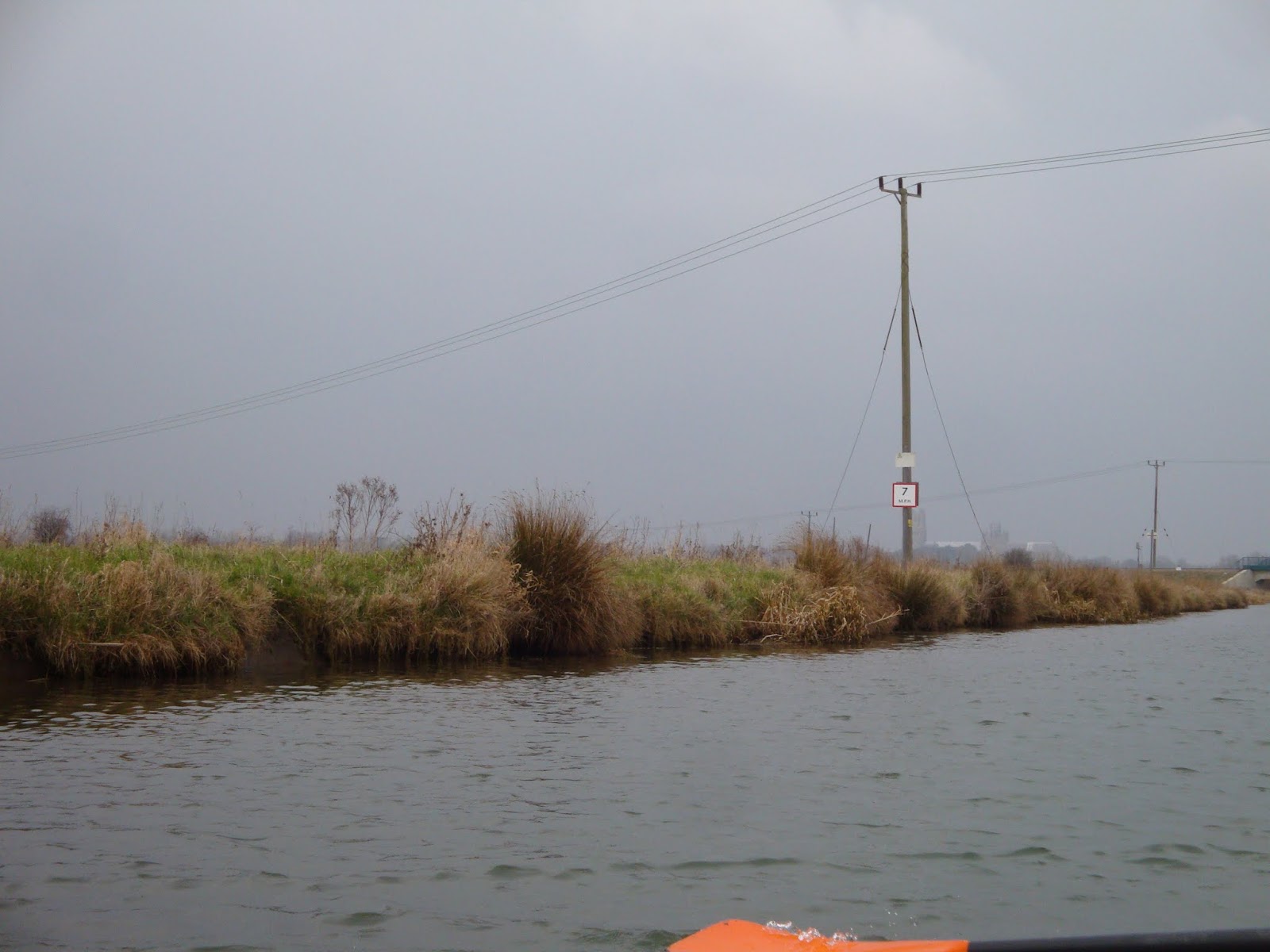
were poled out. From the lock onwards we entered the true flatlands where
nothing broke the winds that swept across the country and ruffled up the water.
Cox looked cold, but she kept up her rhythmic banter. We were about one third
of the distance to Ely. Again we settled into Stroke’s metronomic pace. More
gulls. Lots and lots of vole holes. The lovely seed heads of Phragmites reeds that always make me
think of the Nile. But it didn’t feel like the Nile, even if the sun did break
through the clouds for a few luxurious minutes. The problem with this part of
the row was that there were so few landmarks. We paddled past places that
described themselves as marinas – which seemed lavish descriptions of rather
tatty boatyards. We saw a couple of oystercatchers, quite a lot of Canada
geese, and some greylags.
 |
| Which way now? |
Cox had us row Firm Pressure for 20 strokes, then Half
Pressure. She’s skilled in keeping up the interest – if you can call it that.
This row would have been an unimaginable challenge without her banter. I felt I
was just about the right temperature. She must be freezing. The snow started
again. Shafts of sunlight spotlit patches of Fen for a while; then a surprisng glimpse of a little egret (a new treat for this country - especially in winter). We encountered a choice of ways. It was signposted. I had no idea how
much further, but my back was aching and my hips were complaining, and I felt
as if I was messing up more strokes. I’d emerge from automatic pilot to realise
I was out of time, and cursed. Not knowing stroke too well, I restrained myself
for uttering the S word.
On we paddled. A brief moment of interest when I saw
something that might have been a grebe, but decided it was another cormorant. A
bridge. Some lonely landing places for narrow boats. Then a really good view of
a Great Crested Grebe – one of my favourite birds. That pleased me. And on.
Hips really sore. Back really painful. The cox said, ‘I see Ely cathedral!’
 |
| Can you see Ely Cathedral in the distance? |
 We pulled in for a drink of water and Stroke’s Harriboes .
There was a large freshwater mussel in the shallow mud. I couldn’t help
recalling someone saying, you see the cathedral and think you are nearly there,
but it’s still a long, long way. We started again. ‘Catch - together. Feather –
together.’ Then a sign ELY 4 MILES.
Damn. And we have to row a mile beyond Ely. Think about something else. The
population of water voles. I’d love to see another – but they’re all sensibly
in their burrows. ‘Catch – together.’ And back into automatic pilot.
We pulled in for a drink of water and Stroke’s Harriboes .
There was a large freshwater mussel in the shallow mud. I couldn’t help
recalling someone saying, you see the cathedral and think you are nearly there,
but it’s still a long, long way. We started again. ‘Catch - together. Feather –
together.’ Then a sign ELY 4 MILES.
Damn. And we have to row a mile beyond Ely. Think about something else. The
population of water voles. I’d love to see another – but they’re all sensibly
in their burrows. ‘Catch – together.’ And back into automatic pilot.
A long time later cox said something about a bridge. I
registered traffic. We were in Ely. Not much further. Another mile. This far
and no new blisters. Quads tired. Jane tired. Glance at the cathedral, dominating
the landscape. Magnificent structure but I didn’t really care.
Cox said something about some barns up ahead. ‘I think that’s
where we stop. Not much further now.’ And she was right. We arrived, spun and
landed. Cox was hypothermic and needed shoe-horning out of her seat. I felt I
audible creaked as I scrambled out and straightening up. But there was the
smell of bacon in the air. The Isle of Ely Rowing Club were serving hot drinks
and BACON BUTTIES. There’s nothing like a bacon buttie when you’re really
hungry. We’d been going for about 4 hours – 3.5 of that was rowing; 17 miles. It
had been gruelling. We’d deserved the hot chocolate; we were satisfied, content. I reckon and
that thought (and more importantly the buttie) sustained us while we dismantled
the boats and got them on the trailer. Contentment is definitely all about
contrasts.